





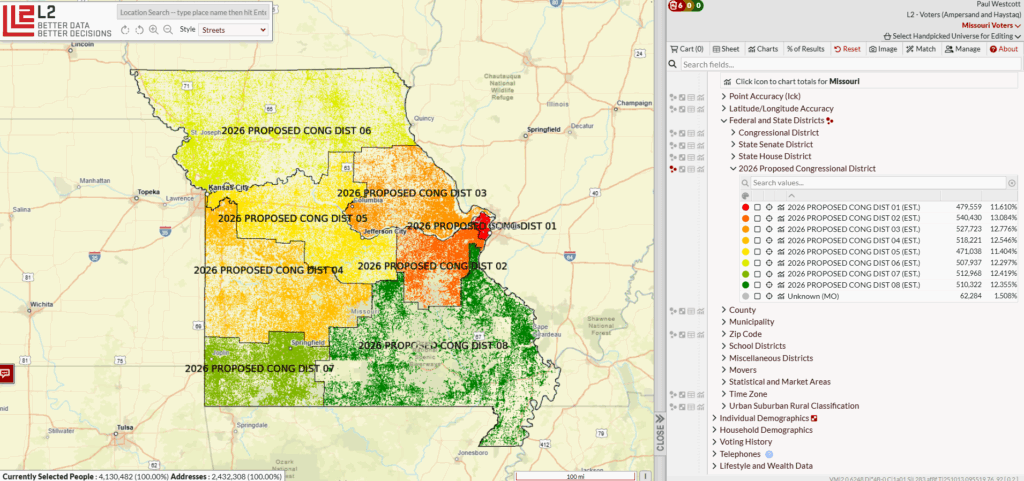
Following the 2020 Census and the delays caused by COVID, L2 was the first data provider to make both proposed and finalized district data available to our users. With over 50 years of experience, a dedicated acquisitions team, and strong relationships across every state, L2 remains the most trusted source for navigating expected and unexpected district changes.
Contact us to learn more or explore the latest proposed districts directly in L2 DataMapping.
Below is a window into our process:
1. Monitor & Acquire
L2 tracks redistricting activity across all 50 states, collecting official shapefiles directly from state legislatures, redistricting commissions, and court repositories as soon as maps are proposed or adopted.
2. Verify & Standardize
Each file is validated, cleaned, and aligned to Census blocks and L2’s internal geography. GIS teams confirm boundary integrity, resolve overlaps, and ensure consistency across precinct, county, and district layers.
3. Match to Voters
Voter records are re-coded to both current and proposed districts using Census block matching, allowing side-by-side analysis of how new boundaries shift the electorate.
4. Publish Across Platforms
Verified boundaries are pushed to L2 DataMapping, Snowflake, LiveRamp, and Zip-to-District tables, with clear labeling for proposed vs. final maps.
5. Maintain & Update
L2 continuously tracks court rulings and mid-decade redraws, maintaining legacy and current layers for historical analysis and consistent client delivery.
How are L2 district data used by campaigns, organizations, advocacy groups, governments, PACs, associations, and some of the world’s largest media organizations?
Helping Draw the Lines
L2 data and L2 DataMapping are trusted by redistricting commissions, legislatures, governors’ offices, and advocacy groups nationwide. These tools are used to draw, analyze, and evaluate proposed districts with precision and transparency.
Litigating the Lines
When district boundaries are challenged in court, L2 data provides an authoritative view of the electorate — a “source of truth” used to support or contest maps across multiple states.
Proposed Districts
Once new boundaries are introduced and appear likely to be adopted, L2 incorporates the official shapefiles to provide clients with an early, accurate view of voters in those proposed districts — both in L2 DataMapping and in our core taxonomy.
Zip-to-District Product
For digital platforms and organizations targeting both current and proposed boundaries, L2’s Zip-to-District tables provide rolling updates at the ZIP, ZIP+2, and ZIP+4 levels for U.S. Congressional and State Legislative Districts — with separate outputs for proposed and finalized maps.
New Districts
Once final districts are adopted, they appear side by side with the existing ones in L2 DataMapping, Snowflake, LiveRamp, and our full data taxonomy.
Contact us to learn more or explore the latest proposed districts directly in L2 DataMapping.